Games
Kite
Built by Nathaniel Sarmiento
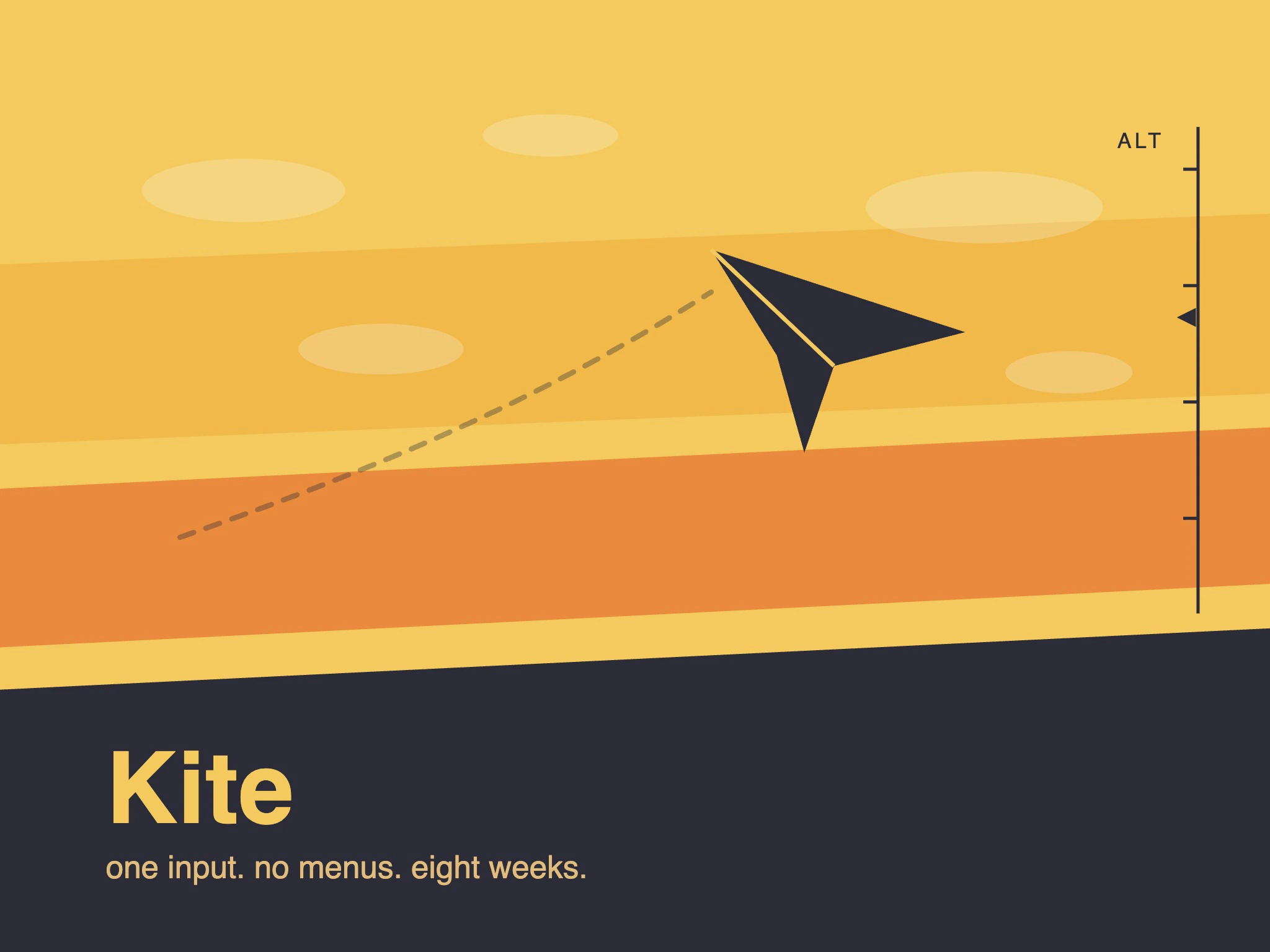
A small game about steering a paper plane on thermals, which I finished after my thesis mostly to prove I could finish something.
Builder email verified
Verification
- Type
- Personal
- Category
- Games
- Published
- Jul 25, 2026
- Updated
- Jul 25, 2026
About this project
- What I built & why
I had started maybe six games and finished none, which by my last year of university had become an actual problem in my head rather than just a hobby thing. So I picked the smallest idea I could stand — one mechanic, no menus beyond start, no story — and made a rule that I would ship whatever it was in eight weeks. Kite is what came out. It exists because I wanted the experience of finishing more than I wanted the game to be good.
- The problem
It does not solve a problem, it is a game. What it is for, if anything, is the ten minutes on a commute where you want something with no text in it. You steer a paper plane through rising and falling air, trying to stay up; there are no lives, no score attack, and the run ends when you land. A few people have told me they use it the way you use a fidget toy, which is more than I expected.
- What I owned
All of it, including the art, which is why the art is three colours and some triangles. The interesting piece is the air simulation — a coarse grid of thermal cells that drift and decay, sampled with smoothing so the plane feels like it is in a current rather than snapping between cells. I did the input handling, which is one axis and took an embarrassing amount of tuning, and the whole build and release. There is no code from anyone else in it.
- Technical & product decisions
One input and no menus was the constraint I set on day one and the reason it exists — every feature idea I had, I wrote on a list instead of building, and the list is still there with about forty things on it. I chose a fixed timestep for the physics and interpolated rendering, which was more work than I needed at this scale but meant the feel is identical on a phone and on my laptop; the first version was frame-dependent and played completely differently on the two. I also deliberately did not add difficulty progression. The air gets harder because you get further, not because a number went up.
- Hardest challenge
Making the plane feel right was the whole eight weeks compressed into one problem, and there is no correct answer to check against. My first version was physically reasonable and horrible to play — the plane responded truthfully to the air, which meant you were a passenger. What fixed it was giving the player's input more authority than physics would allow and letting the air bias rather than dictate, plus about two hundred small tweaks to the response curve tested on a friend who had never played it. I learned that 'realistic' and 'good' are different targets, which I had read many times and did not understand until then.
- Result & impact
I finished it, which was the actual goal and which I had failed at six times. It has been downloaded around four thousand times with no promotion beyond one forum post, and it has a small number of people who have left notes saying it is calming. Two of the techniques — the fixed timestep and the smoothed field sampling — I have reused since. It made me measurably better at knowing when something is done.
- Who else worked on it
A friend from my course playtested about thirty builds and is the reason the controls are what they are. My thesis partner made the three sounds in it on his phone.